

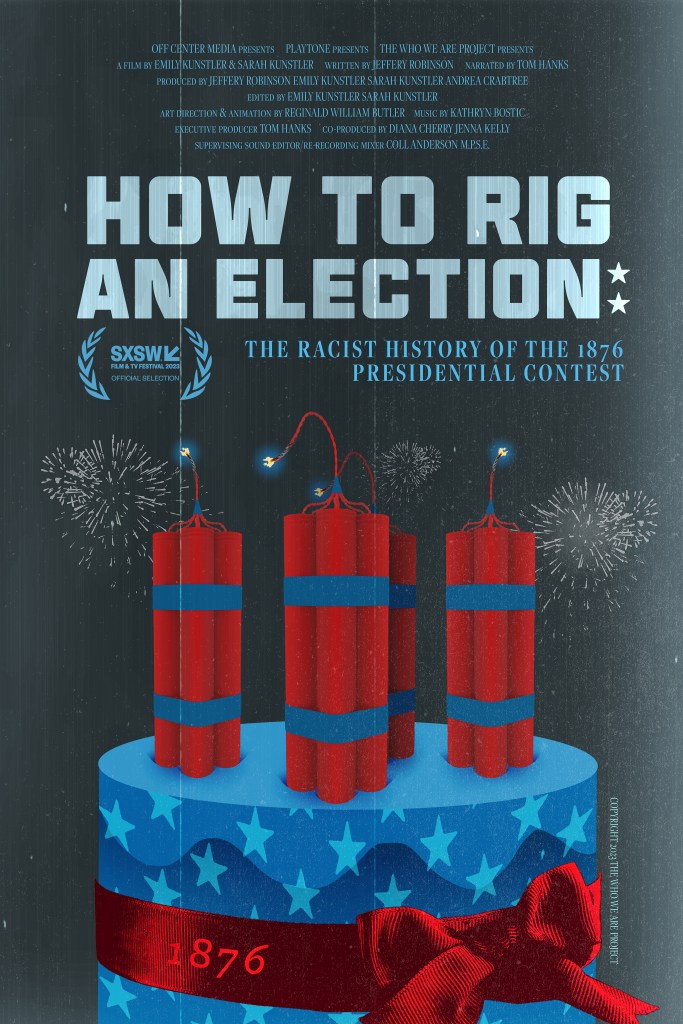
How to Rig an Election: The Racist History of the 1876 “Compromise” is a short historical docu-film with animated elements, about the compromise made during the 1876 election and the racial consequences that followed. Narrated by Tom Hanks, this film tells of the growth and progress of the United States, but even as our economical, political, and technological wealth grew, our societal wealth was at an all time low, and sinking.
To secure a Rutherford B. Hayes (republican) election victory, he made the decision to retract his union troops from the southern states, which allowed those states the freedom to govern as they pleased. The “then” racist democratic party wanted this outcome, which allowed racism in the south against blacks to almost flourish. This all came over a decade after slavery had ended.
Thank you to Emily for the interview. Here is what she had to say:

Q: What inspired you to start making films?
As sisters, we’ve always been interested in the power of storytelling. We began documenting the world around us at an early age. Our parents were both civil rights attorneys and Sarah and I would hide beneath our father’s desk with an audio recorder documenting his work.
In 1999, over ten percent of Tulia’s Black population was arrested in a drug bust conducted by one undercover agent with questionable motives and no corroborating evidence. The first defendant was sentenced to over 300 years. I was still in film school at the time and Sarah (now a lawyer) had yet to enter law school but we were outraged by what we’d heard about the case. So, we flew to Texas and started filming.
Over the next few years, the film garnered publicity for the case, helped secure legal representation for the defendants, and inspired changes to Texas law. Ultimately, all 46 people arrested were exonerated and received a settlement from the state of Texas for the harm they experienced.
The experience showed Sarah and I the power of film to inspire real change and we’ve been making films with our production company, Off Center Media (www.off-center.com), ever since.
We met Jeffery Robinson, the writer and producer of our short, How to Rig an Election: The Racist History of the 1876 Presidential Contest, in 2017 after Sarah heard him speak about the history of anti-Black racism in New York City and have collaborated with him and his team on a number of projects.
Q: Were there any challenges in making this project?
This project was the brainchild of Jeffery Robinson, CEO and Founder of The Who We Are Project (www.thewhoweareproject.org). In 2022, Sarah and I completed a feature length film with Jeff called Who We Are: A Chronicle of Racism in America. In it, we tackle many events in history that confront anti-Black racism in the United States, but there was still so much we couldn’t include.
When Jeff shared the story of the events surrounding the 1876 election, we knew it was a story with powerful implications for many of the political challenges we are facing as a nation today.
The greatest challenge we faced while making this film was figuring out how to make a visually compelling short documentary about something that happened almost 150 years ago. Sarah had the idea to incorporate old Thomas Nast illustrations from the time that had been published in Harper’s Weekly and those gave us our visual style and the credibility of a documentary based on primary source materials. Our very talented animator, Reginald William Butler, was able to bring these illustrations to life.
Q: Is there any type of message or emotion that you hope the viewer takes away from watching this film?
We hope the film inspires viewers to consider the longstanding implications of elections, particularly presidential elections. The 1876 “Compromise” had a chilling effect on the civil rights of newly freed Black people. The indictment of a former president and 6 unnamed co-conspirators for attempts to overthrow the government demonstrate just how important it is to know our history.
Efforts to subvert the will of the people can and do have dire consequences then and now. The motives and values behind the attempts to whitewash history curriculums and ban books can already be seen at work as some respond to criminal charges relating to January 6 by saying no insurrection occurred – it was just tourists at the Capitol. The truth matters.
One of the goals of The Who We Are Project is to correct the narrative on our shared history of anti-Black racism in the United States so that we can have a clear understanding of why the United States looks like it does today. This short film tells just one of the many important stories that expose the history of who we were, who we are, and what we need to do to become who we aspire to be as a nation.
By telling just one of many stories of our nation anti-Black past, we hope to inspire viewers’ curiosity about our nation’s true history.
Q: How does it feel to be able to screen the film at HollyShorts?
We are very excited to be included as part of this year’s program at HollyShorts. We can’t wait to share this film with your audience. We are thrilled that our animator, Reginald William Butler, will be in attendance at the festival representing our film and participating in the post screening Q&A.
Q: What’s on the horizon for you?
Our goal is for this short film to be the first of many in a series illuminating different moments in history and uncovering the racist history that has been hiding in plain sight. We will continue to collaborate with Jeffery Robinson and The Who We Are Project as “The Racist History Of…” explores everything from abortion, to the role that fear of revolts by enslaved people played in debates about the second amendment, to military recruitment. The series will shed light on oft forgotten, hidden, or unexamined truths about U.S. history and reveal the continued impact of these systems on reinforcing systemic racism in the U.S. today.
This series will join and inform an urgent national dialogue. The legacy of slavery and the history of anti-Black racism in the U.S. is not only Black history, it is American history. It is our shared inheritance. Its legacy is still felt in many aspects of American systems, institutions and society today.
Beginning to learn about this history in a series of short, animated films encourages audiences to engage and reckon with it in both the past and the present. With fear of “Critical Race Theory” used to justify erasing Black history, this content couldn’t be more timely. We believe the only way to move forward is to learn, and reckon with, our country’s past. We are looking for partners who are interested in being a part of this effort, helping us secure funding and share this series with the largest possible audience.
A big thank you to Emily for taking the time to talk with us. You can see their film and many others at the HollyShorts Film Festival, which runs from August 10th-19th in Los Angeles at the TCL Chinese Theater. Tickets for the festival, as well as the screening schedule, can be found here. They can also be viewed digitally, with tickets available on BitPix.
 BITPIX TV News